


Future-Proofing Your Child
November 26, 2025 Gitika Kapoor
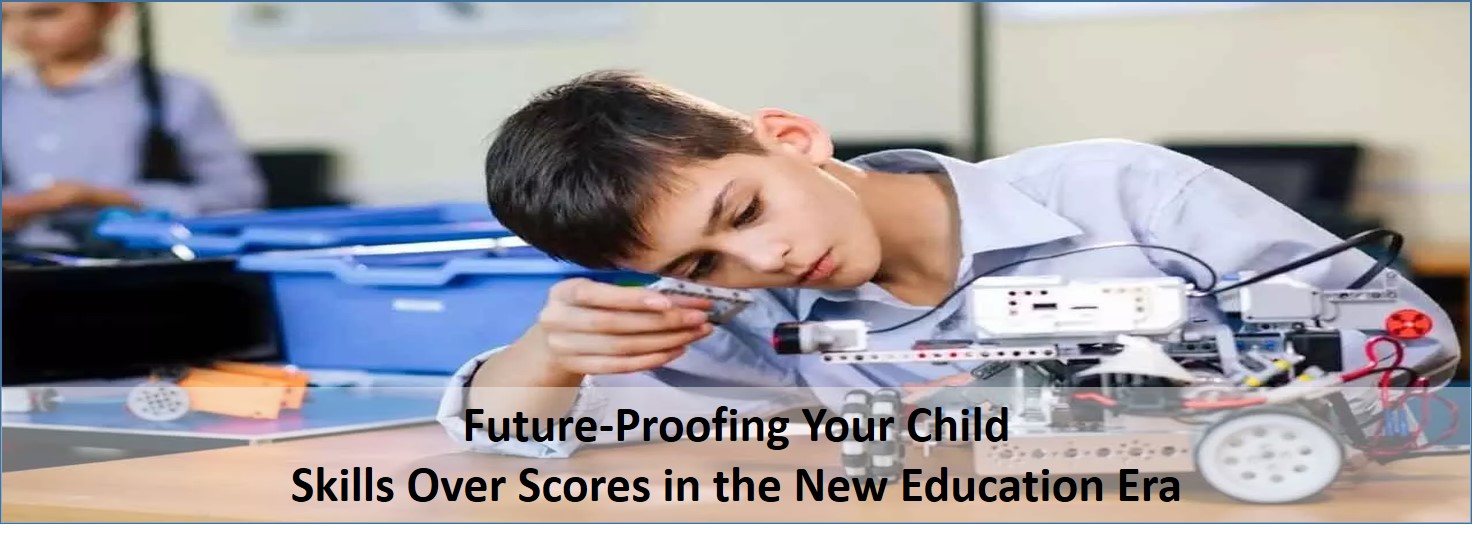
Future-Proofing Your Child: Skills Over Scores in the New Education Era
The world changes faster every year, and as a parent or community member, you feel that pressure when you look at your child’s education. The school system we grew up with—focused on standardized tests and memorizing facts—simply can't prepare students for a future defined by constant change.
We are in the middle of a necessary transformation, moving away from the old "factory model" and toward an approach designed for innovation.
Today: Moving Beyond Memorization
The single biggest shift in education right now is realizing that knowledge is everywhere. When your child can access every piece of information instantly, the value of memorization drops to zero. What matters now are the skills to handle that information: critical thinking, creativity, collaboration, and communication.
This is why you hear so much about Personalized Learning. This isn't just a buzzword; it's the commitment to meeting your child where they are. Using modern tools, we can understand exactly which concepts a student has mastered and which ones still need work. This allows us to tailor their journey—making sure a struggling student gets targeted support, and a fast learner gets accelerated, challenging projects. It’s about building mastery, not just moving them along the assembly line.
Crucially, we're placing heavy emphasis on Social-Emotional Learning (SEL). A child who can manage their anxiety, understand their strengths, and work respectfully in a team will outperform a brilliant but isolated student every time. We are consciously teaching resilience and empathy because those are the foundational skills needed for success in college, career, and life itself.
Our Vision: Competence, Character, and Citizenship
When we look toward the next decade, our vision for education must be about future-proofing our children. We are preparing them for jobs that don't exist yet, which means focusing on competency-based learning. This means ensuring a student has genuinely mastered a real-world skill, like running a complex project or analyzing data, rather than simply scoring above a threshold on a test.
The future classroom is fluid and interconnected. We are breaking down the traditional walls between subjects, connecting physics to ethics, and math to art. This interdisciplinary approach teaches students to solve problems holistically—just as real-world challenges exist.
Most importantly, our mandate is to cultivate responsible global citizens. In an era of rapid information and misinformation, our children need the ability to evaluate sources, understand diverse perspectives, and engage constructively with complexity. We are teaching them to be contributors, not just consumers, of the global dialogue.
The greatest tool in our schools is, and always will be, the human teacher. As new technologies like AI enter the system, they serve as powerful tools, but they never replace the inspiration, encouragement, and emotional guidance only a dedicated adult can provide. Our future isn't about replacing the teacher, it's about amplifying their ability to connect with your child and empower them to shape the world.

Gitika Kapoor
PRT