


From Floppy Disks to AI: Helping Our Kids Navigate the Digital World
February 10, 2026 Karishma Shah
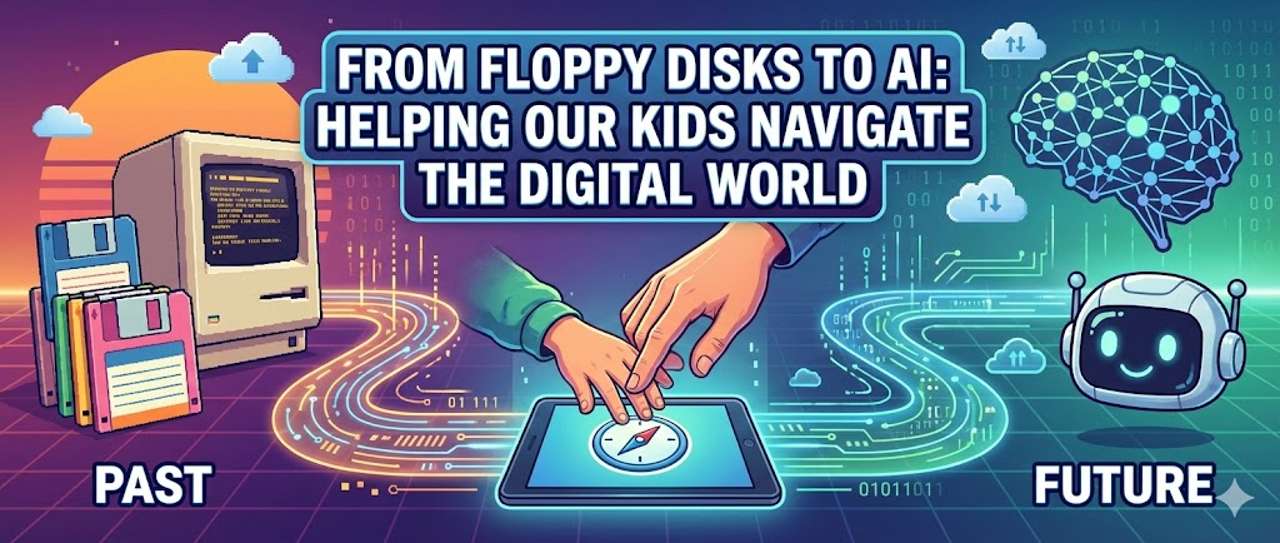
From Floppy Disks to AI: Helping Our Kids Navigate the Digital World
Remember when the most stressful thing about technology was making sure nobody picked up the landline while you were on the internet? Fast forward to 2026, and our kids aren't just "using" the internet—they’re living in it with AI best friends and viral deepfakes. The gap between a floppy disk and an AI Agent isn't just a few decades; it’s a whole different universe.
As a computer teacher, I see this shift every single day. We aren't just talking about "too much screen time" anymore. We are in a world where technology is the atmosphere our students breathe. Here is the lowdown on what’s actually happening and how we can help our kids stay on track.
1. Homework: From "Googling it" to "AI-ing it"
Remember when we taught kids how to search on Google? In 2026, that feels like ancient history.
• The Numbers: A 2026 education report shows that 86% of students now use AI to help with schoolwork. It’s not just for small tasks; 1 in 3students admits to using AI to generate entire first drafts of their essays.
• The Problem: It’s tempting for kids to let the AI do the thinking. If the AI writes the essay, the student isn't actually learning. We are seeing a 15% drop in traditional research skills because kids are skipping the "search" and going straight to the "answer."
• How to Help: Parents, instead of just asking "Is your homework done?" try asking, "Can you explain this to me in your own words?" We need to make sure our kids are still using their own brains, not just hitting "copy and paste."
2. Social Life: Real Friends vs. AI Friends
Social media used to be for sharing photos with friends. Now, it’s a lot more complicated.
• The Numbers: This year, roughly 52% of teens are hanging out with "AI Companions." On average, students are spending up to 2 hours a day chatting with AI bots that are programmed to be their "perfect" friend.
• The Problem: Real friends are messy. They disagree with you and sometimes they hurt your feelings. AI friends are "perfect," which means kids might lose the habit of dealing with real, complicated humans. In fact, studies show that 40% of heavy AI users report feeling more anxious in real-life social situations.
• How to Help: Encourage "phone-free" hangouts. Remind your kids that while an AI can chat, it can't actually feel for them. Nothing beats a real conversation with a real person.
3. Seeing is No Longer Believing (The Deepfake Issue)
We used to say, "Don't believe everything you read on the internet." In 2026, we have to tell them, "Don't believe everything you see."
• The Numbers: AI-generated "Deepfakes" have increased by 900% since 2023. About 74% of people are worried about how easy it is to fake a video or a voice, and schools have seen a 30% rise in digital identity bullying.
• The Problem: Imagine a fake video of a student saying something mean goes viral. Even if it’s a total lie, the social drama is very real and can be incredibly stressful for a teenager to handle.
• How to Help: Teach your kids to be "Digital Detectives." If a video seems too crazy to be true, tell them to stop and check the source before they share it or get upset.
Then vs. Now: A Quick Look
| Feature | The "Then" (Parents' Era) | The "Now" (2026 Reality) |
| Finding Info | Looking in a library book | Asking an AI Agent |
| Daily Screen Time | 1-2 hours of TV | 7-9 hours of digital interaction |
| Privacy | A diary with a little lock | A permanent "Digital Footprint" |
| Trust Factor | If you see it, it's real | Everything is potentially edited |
A Final Thought from the Classroom
Technology is moving faster than any textbook. But here’s the good news: Computers still need humans to tell them what to do. Parents, you don’t need to be a tech genius. You just need to be a "Humanity Expert." Teach your kids to be kind, to ask questions, and to put the phone down once in a while. The apps will change, but those life skills will never go out of style.